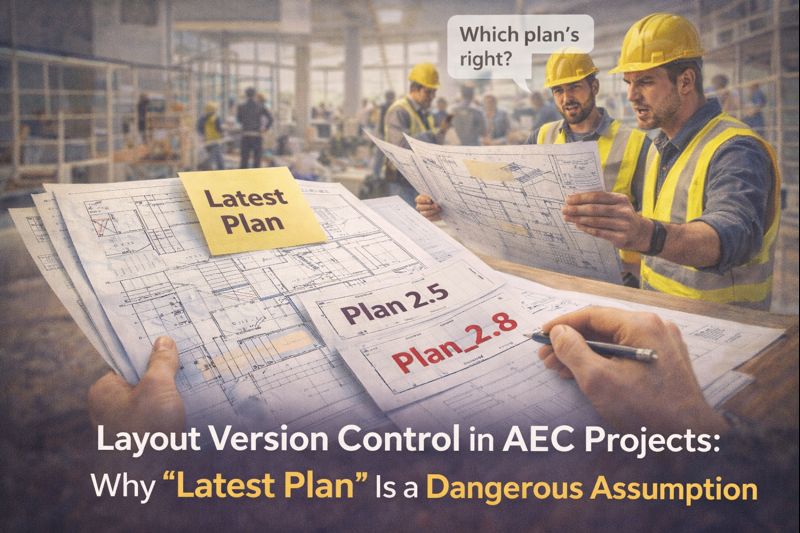
Introduction: The Floor Plan Is Treated as Final Too Early
Few documents feel as authoritative as a floor plan.
Once it’s approved:
- teams assume stability
- consultants start locking systems
- quantities get referenced
- furniture, structure, and MEP align around it
And yet, floor plans are rarely finished when they’re approved.
They’re simply accepted under incomplete understanding.
This is why floor plans are responsible for more downstream redesign than almost any other design artifact.
Floor Plan CRM exists to manage what happens after approval—when layouts start interacting with reality.
Short Briefing: Who This Pillar Is For
This article is written for:
- architects managing planning stages
- interior designers handling layouts
- space planners & workplace teams
- developers reviewing feasibility
- PMs coordinating early delivery
If your projects suffer from late layout changes, coordination pain, or “this worked on plan” problems—this pillar is for you.
The Hidden Truth: Floor Plans Are Decision-Dense, Not Just Drawings
A floor plan isn’t just geometry.
It encodes decisions about:
- adjacencies
- circulation logic
- density
- flexibility
- compliance assumptions
- future adaptability
Many of these decisions are implicit. They aren’t discussed, documented, or tracked.
When constraints appear later, teams argue not about what changed—but about what was assumed.
Why Approval Doesn’t Mean Alignment
Clients approve floor plans because they recognize spaces:
- rooms
- corridors
- labels
They don’t yet experience:
- circulation pressure
- furniture conflicts
- service congestion
- daylight behavior
Design teams approve plans because they intend to refine later.
These two interpretations coexist quietly—until coordination begins.
Approval without shared understanding creates fragile certainty.
The Gap Between Planning and Coordination
Most tools handle:
- drawing floor plans
- coordinating BIM models
Very few tools manage the transition between them.
That transition is where:
- layout assumptions harden
- changes become expensive
- accountability blurs
Floor Plan CRM exists in this gap.
It ensures that:
- layout decisions are traceable
- assumptions are visible
- changes are contextual
- approvals retain meaning
Why Late Layout Changes Are So Disruptive
Once consultants align around a plan:
- structure locks grids
- MEP routes systems
- fire strategies define paths
- furniture layouts finalize density
A single layout change now triggers cascading rework.
What felt flexible earlier becomes politically and technically painful.
Floor Plan CRM helps teams stress-test and manage layouts before this hardening occurs.
Why Spreadsheets and Emails Don’t Work Here
Layout decisions are usually tracked informally:
- comments on drawings
- emails after meetings
- verbal agreements
Weeks later, no one remembers:
- which version was approved
- what assumptions applied
- what alternatives were rejected
Floor Plan CRM captures layout intent as a system, not scattered memory.
Floor Plan CRM Is About Protecting Intent, Not Freezing Design
There’s a fear that “CRM” means rigidity.
In reality, Floor Plan CRM:
- preserves flexibility early
- records why changes happen
- prevents accidental drift
Design remains iterative—but no longer chaotic.
Where Floor Plan CRM Fits in the AEC Stack
Floor Plan CRM sits:
- after concept & planning
- before heavy BIM coordination
It connects:
- early layouts
- approvals
- assumptions
- downstream coordination
And when layouts mature into full delivery, platforms like Ruwaq Design extend this layout intelligence into BIM coordination and execution—so early planning logic isn’t lost under technical pressure.
How Floor Plan CRM Turns Layouts Into Managed Decisions
Layout Problems Don’t Come From Drawing — They Come From Drift
Most layout issues are not design mistakes.
They are unmanaged changes.
A corridor shifts slightly to solve one issue.
A room grows to satisfy a user request.
A core edge moves to align with structure.
Each change feels local and reasonable. But floor plans are highly interconnected. One adjustment ripples into circulation, density, furniture, services, and compliance.
Without a system, those ripples go unnoticed until coordination exposes them.
Floor Plan CRM exists to make layout drift visible before it becomes expensive.
Version Control Is Not Enough Without Intent Tracking
Most teams track versions:
- Plan A
- Plan B
- Latest Issue
But version control alone doesn’t explain why changes happened.
When consultants ask:
“Why did this wall move?”
or
“Which version is actually approved?”
Teams often answer from memory.
Floor Plan CRM tracks:
- what changed
- why it changed
- who approved it
- what assumptions applied
This turns versions into decisions with context, not just files.
Tracking Assumptions Is More Important Than Tracking Geometry
Early floor plans are built on assumptions:
- expected headcount
- furniture standards
- operational patterns
- compliance interpretations
Many of these assumptions are implicit. They live in designers’ heads, not in drawings.
When assumptions change later, teams argue about outcomes instead of causes.
Floor Plan CRM captures assumptions explicitly—so when reality shifts, teams understand what needs revisiting and why.
Managing Layout Changes Without Stopping Design
There’s a fear that tracking changes will slow creativity.
In practice, unmanaged changes slow projects far more.
Floor Plan CRM allows teams to:
- explore alternatives freely
- record what was tested
- clarify what was rejected
- explain why one option moved forward
Design remains fluid early—but becomes intentional instead of accidental.
Making “Approved” Mean Something Again
Layout approval often becomes meaningless because context disappears.
Approved for what?
- Concept only?
- Headcount assumption?
- Budget range?
Floor Plan CRM ties approvals to:
- specific versions
- defined assumptions
- known constraints
This prevents silent re-interpretation later and protects teams when conditions change.
Improving Consultant Coordination Before BIM Chaos
Consultants don’t break projects.
They expose weak layouts.
When MEP, structure, and fire teams engage:
- they lock around what they see
- they assume stability
- they optimize within constraints
If layouts aren’t stable by intent, coordination becomes defensive.
Floor Plan CRM ensures consultants receive:
- the correct layout version
- clear status (provisional vs stable)
- known assumptions
- pending decision areas
Coordination becomes collaborative instead of reactive.
Why PMs Need Layout Visibility, Not Redlines
PMs don’t need to review every drawing.
They need signals.
Floor Plan CRM helps PMs see:
- where layouts are changing frequently
- which areas are unstable
- what decisions are blocking coordination
- where approvals are pending
This allows PMs to intervene early—before issues escalate into delays.
From Layout Control to Full AEC Execution
Once layouts stabilize, they become the backbone of delivery.
If layout intent disappears at this point:
- BIM coordination suffers
- scope drifts
- rework multiplies
This is where platforms like Ruwaq Design extend Floor Plan CRM intelligence into BIM coordination and execution—ensuring that layout decisions, assumptions, and approvals remain visible where technical complexity increases.
Early planning logic doesn’t get overwritten by downstream pressure.
How Floor Plan CRM Reduces Rework, Prevents Disputes, and Enables Scalable Planning
Rework Rarely Starts in BIM — It Starts in Layouts
When teams talk about rework, they usually blame coordination.
Clashes.
System conflicts.
Late changes.
But in many projects, BIM is only revealing what was already unstable.
The root cause is often layout uncertainty that was never resolved, only postponed.
Floor plans that were approved too early.
Assumptions that were never validated.
Decisions that felt temporary but became permanent by default.
Floor Plan CRM reduces rework by forcing clarity before layouts harden into systems.
Why Layout Rework Is So Expensive
Layout changes are deceptively small.
Moving a wall by 300mm feels trivial on paper.
In reality, it can affect:
- furniture layouts
- circulation widths
- fire egress paths
- duct routing
- sprinkler coverage
- lighting grids
The later a layout changes, the more systems it touches.
Floor Plan CRM shifts changes earlier, when they are still cheap and negotiable.
Disputes Begin When Intent Is Forgotten
Most layout-related disputes don’t involve mistakes.
They involve interpretation.
- “We thought this room was flexible.”
- “We assumed the corridor width was final.”
- “We approved the plan, but not this outcome.”
Without recorded intent, every party remembers approval differently.
Floor Plan CRM prevents this by preserving:
- what was approved
- under which assumptions
- for which stage
- with which known constraints
When intent is visible, disputes lose momentum.
Why Layout Governance Improves Client Trust
Clients don’t expect layouts to be perfect immediately.
They expect clarity.
When changes happen with:
- explanation
- traceability
- visible reasoning
clients feel involved, not surprised.
Floor Plan CRM improves trust by making layout evolution transparent—not by locking designs prematurely.
Scaling Planning Teams Without Losing Control
Small teams manage layouts informally because everyone is close to the work.
As teams grow:
- multiple planners touch the same areas
- decisions overlap
- context gets diluted
- senior designers become bottlenecks
Floor Plan CRM enables scale by:
- preserving shared layout memory
- standardizing decision capture
- allowing safe delegation
- reducing dependence on individuals
Planning becomes resilient instead of personality-driven.
PMs and Directors See Problems Earlier
Leadership doesn’t need every drawing.
They need early warning signals.
Floor Plan CRM allows leadership to see:
- frequent layout churn zones
- unresolved decision clusters
- approvals under pressure
- assumptions that keep changing
This enables timely intervention—before issues cascade into delays.
From Layout Control to AEC Delivery Intelligence
Floor Plan CRM stabilizes layouts.
But layouts don’t exist in isolation. They feed:
- BIM coordination
- scope definition
- procurement
- construction sequencing
If layout intent disappears at this handoff, problems resurface.
This is where platforms like Ruwaq Design extend layout intelligence into coordination and execution—ensuring that what was planned intentionally remains respected as technical complexity increases.
Planning intent survives contact with reality.
Why floorplancrm.com Becomes an Authority Domain
The role of floorplancrm.com is not to talk about drawing tools.
It’s to explain why layouts cause downstream pain—and how to prevent it.
By focusing on:
- layout drift
- assumption management
- approval clarity
- transition to coordination
the domain earns trust from architects, planners, PMs, and developers who already know the problem but lack a system to control it.
Authority comes from solving the quiet failures others ignore.
The Bigger Shift: Layouts Become Managed Systems
For years, layouts were treated as static drawings.
In reality, they are decision systems.
The future belongs to teams that:
- manage layout intent
- track assumptions
- preserve context
- control transitions
Floor Plan CRM is not about control for control’s sake.
It’s about enabling confident progression from planning to delivery.
Final Conclusion
Projects don’t suffer because layouts change.
They suffer because layout changes aren’t managed.
Floor Plan CRM restores control by turning layouts into traceable, contextual decisions—so teams move forward with clarity instead of hope.
The firms that deliver smoothly aren’t the ones that freeze plans early.
They’re the ones who manage change deliberately.